
Technology · The system inspires, people decide
KAIZUNO® strengthens organizations
and their people from within.
When you travel by car, you set a destination. The navigation system determines your location and suggests suitable routes. It takes obstacles into account and helps you arrive safely. The people at the wheel decide which way to go.
The digital KAIZUNO system supports you in just the same way.

The system helps you make well-founded decisions.
With less effort.
The digital KAIZUNO system asks the right questions about your initiative and brings together the experience of the people involved. The AI combines it with expert knowledge, takes over the legwork and suggests next steps. That gives you a shared picture of your situation, and you can decide what to tackle.
How you work with the system.
Think the initiative through.
You describe your organization and what you want to achieve. A suitable success path—that is what we call the guided journey through the five steps—takes into account the people who matter for success.
Pool your experience.
The people involved rate statements and add their experience—at their own pace. They decide for themselves which questions to answer and what to contribute.
Decide and implement.
The reports show differing views and possible causes. You discuss the recommendations, clarify open questions and decide together on the next steps.
Only together does your experience form the full picture.
AI is very good at bringing knowledge together, recognizing patterns and suggesting new ways to solve problems. But AI doesn’t know why the Friday handover keeps getting stuck or why everyone asks Sabine first. That knowledge is spread across many people. Each of them sees a different part of it.
You contribute your experience, question the analysis and clarify what the results mean for your work.
Inside the system · A fictional example in excerpts
Miller & Co. shapes its succession.
Miller & Co. builds assembly workstations and fixtures for other companies. Founder Werner wants to travel and know the business is in good hands. His daughter Nora is taking over the management while customer orders keep running.
Eight people from management, production, engineering, sales and the office share their view on how the handover can best succeed.

At Miller & Co., the handover is carefully planned internally. The open question is whether customers and the bank will trust the new management as much as they have trusted the founder.
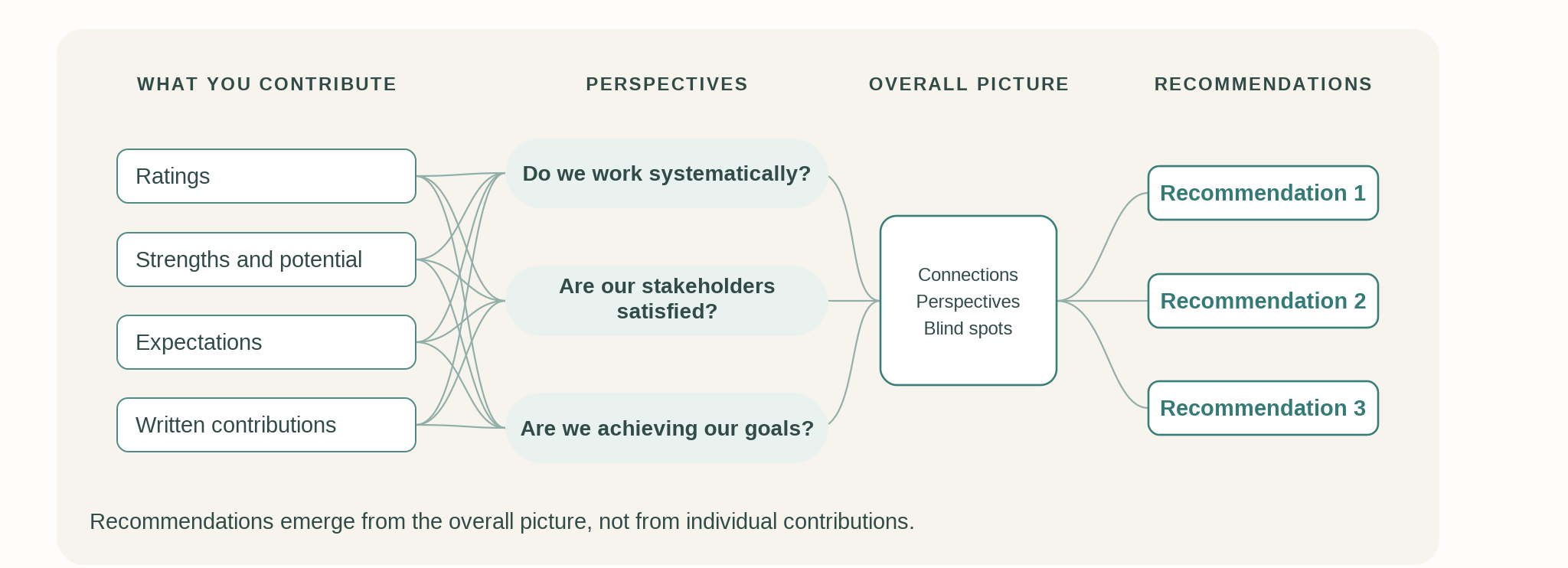
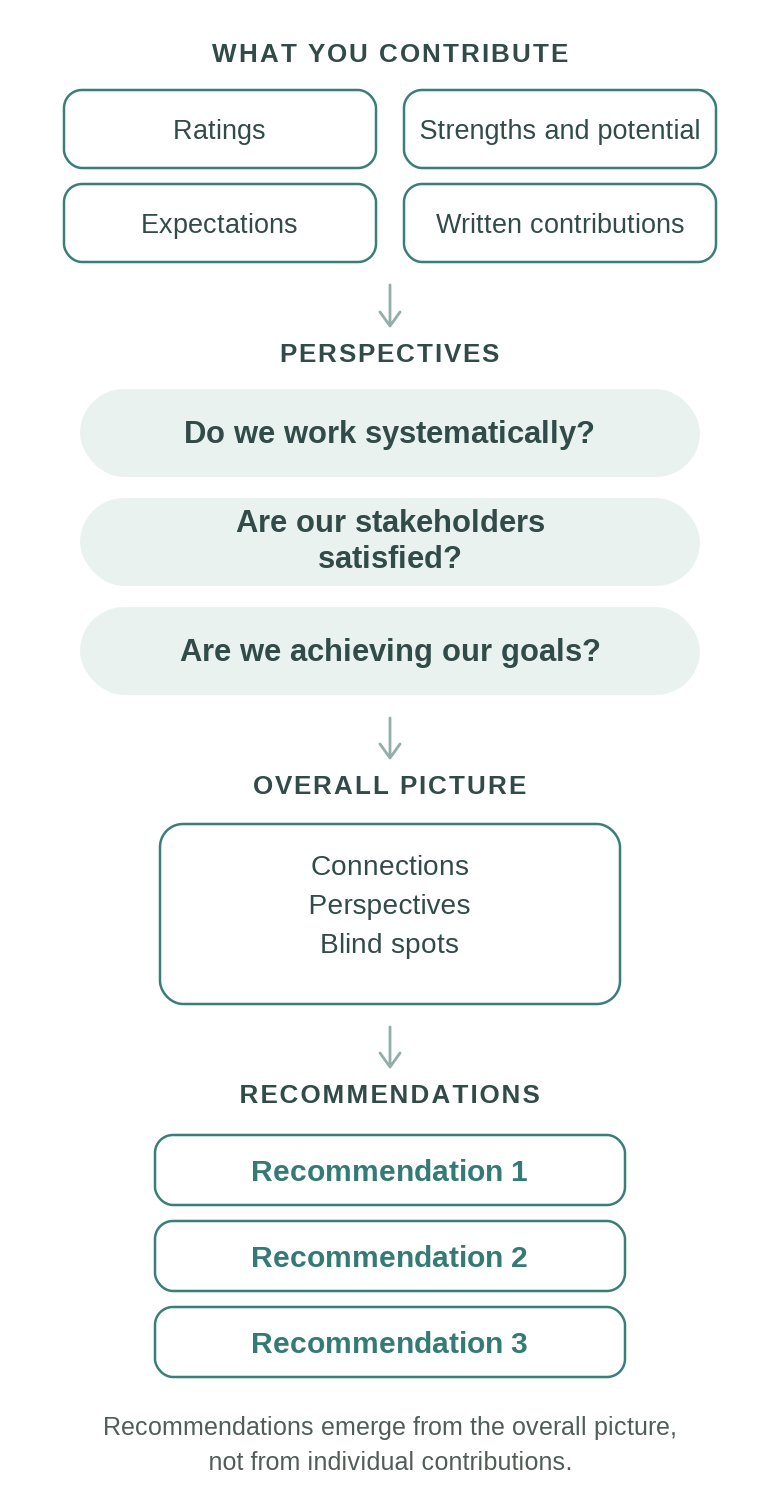
Recommendations emerge from the overall picture, not from individual contributions.
What you contribute
Management sets the success goals in advance. Everything else comes from the eight people involved.
Our success goals
- We want to keep the knowledge our orders depend on within the company.
- We want to transfer the trust of our customers and our bank to the new management.
- We want responsibilities and decision paths that hold after the handover.
What customers and partners expect, in our view
- Series customers in automotive supply expect their fixtures to be ready on time for production start, also during the handover.
- Workshop customers expect a competent contact who knows their equipment, also during the handover.
- Our bank expects a clear plan for who will run the company after the handover and stand behind its financing.
Good practices, rated as a strength or potential
- For every machine, we record how it is set up and why—for example for welding fixtures.
- We write down how we calculate custom builds—for example for one-off fixtures.
- Former and new management hold important customer meetings together—for example for quotes on new models.
Written contributions
“The bank is a formality for us. We’ve known each other for years.”
“With difficult requests, customers still call the boss.”
Perspectives (excerpt)
Success from the perspective of the success goals
Success goal
Do we stand behind it?
Is the plan convincing?
Keep knowledge in the company
all
Strong
Transfer the trust of customers and the bank
almost all
Initial
Responsibilities and decision paths that hold
most
Developing
Keeping knowledge in the company is planned most clearly; how the trust of customers and the bank passes on is planned least. Everyone stands behind keeping the knowledge, most of us behind the decision paths.
Success from the perspective of the stakeholders
Customers
Partners
Maintain relationships
Strength
Strength
Understand current expectations
Strength
Strength
Plan for expectations
Potential
Potential
Measure satisfaction
Potential
Potential
Satisfied
Strength
Strength
Customers are series customers in automotive supply and workshop customers. Our bank is one of our partners.
We know what customers and partners expect, but we hardly plan for it and don’t check whether what we discussed is working. That they are satisfied is therefore mainly our assumption.
Overall picture (excerpt)
Different perspectives
Can we already handle difficult requests without the former management?
Some of us: Yes. The new management and the team know most of the equipment and customers.
Others: Not yet. We are recording settings and calculations, but for custom builds the knowledge still lies with a few people.
Whether responsibility and decision paths hold after the handover depends on this. How would we recognize that difficult requests succeed without the former management?
Causes and effects
Assumed connection
Without planning for customers’ expectations of the handover, their trust may stay with the former management.
Workshop customers expect a contact who knows their equipment, also during the handover. Today, that is mostly the former management. This puts the goal of transferring their trust to the new management at risk.
Potential blind spots
We assume customers and partners are satisfied with the handover, but we don’t measure it.
We rated the bank, for example, as decisive for the handover. We haven’t asked whether what we discussed with it is now working.
How do we actually know that customers and the bank are satisfied?
Recommendations (selection)
Transfer the trust of customers and the bank
Secure the satisfaction of customers and the bank during the handover
Why
We have talked to customers and the bank about the handover. We don’t know whether what we discussed is now working or whether they are really satisfied.
What we do
First, we select the customers with special requirements, such as workshop customers with custom builds or series customers ahead of a production start. We record what we agreed with them and with the bank and add it to the handover plan. Then the new management should ask each of them whether it is working and what is missing. Whatever isn’t working, we fix. Each of these customers gets a fixed contact in the team who knows their orders, and after every delivery we briefly check in. The bank receives regular updates on the handover.
Did it work?
Are these customers and the bank actually satisfied with the handover?
How we notice
Feedback after deliveries is good, what wasn’t working has been fixed, and requests about custom builds go to the fixed contact instead of the former management. The bank confirms the financing for the period after the handover.
How we could start: Management and sales collect what was agreed in the conversations and mark the customers with special requirements.
Goal: Transfer the trust of customers and the bank · For: Customers · Partners
At the organization’s request, the people involved also receive a personal report. It mirrors their own view of the initiative, invites reflection and offers ideas for their own contribution, for example in a joint workshop.
Before you start
Any questions?
How much time does our team need?
That depends on how deep the assessment goes. From experience: a quick assessment takes around 30 minutes per person. A full 360-degree assessment, with everything that goes with it, takes several hours up to a day per person—spread over several stages, alongside day-to-day work. Each person decides how much time to invest. The more thoroughly everyone engages, the better the results.
How quickly results are available depends on the scope and on when everyone can take part. You choose the scope yourselves, from compact to comprehensive.
First results are available after the quick assessment; an in-depth assessment then takes you into the details that matter.
When everyone takes part at the same time, results are even possible on the same day: a team of 15 experts completed an assessment of a complex initiative in two and a half hours.
In most cases, though, it pays to take more time: people who answer without time pressure reflect more. For large initiatives, we recommend one to three weeks, especially since people are rarely all available at the same time—holidays, shifts, field work. It shouldn’t take longer than that, or the momentum is lost.
One person handles the one-time setup. This takes some deliberate time, but it is already work on the initiative itself. The system takes care of the analysis and the reports entirely. That leaves your time together for what matters: thinking things through and deciding.
Who should take part?
Involve the people who know the topic from daily work, who are affected by it or who are needed to implement it. Different roles and experiences help you get a more complete picture.
Not everyone has to answer everything. Everyone contributes where they know something and want to take part. One person coordinates the process and invites the participants—we call them the “guide.” That can be a manager or an intern.
What about data protection?
No confidential data is needed: public information is enough to describe your organization; trade secrets or customer data are not necessary. You decide for yourselves what you enter.
The team analysis is done by role. Personal reports belong to the person concerned. And you always see the original answers from which the AI derives its interpretations.
Storage, calculations and PDF creation are encrypted and run on servers in Switzerland and Europe. Your data is not used for comparisons with other organizations. You can delete it yourselves—individually or completely. And the most important part happens outside KAIZUNO anyway: you implement your initiative in your own organization—in your daily work, on your systems.
In practice · Artificial intelligence
How do you use AI sensibly? Taking KAIZUNO as an example.
AI is changing our lives—when we write, when we search, in our daily work. The question is no longer whether it can do something, but how to use it sensibly—and what not to use it for. Studies such as MIT’s 2025 report show: five questions decide whether a business succeeds with AI.
How do we handle it ourselves?

“Whether KAIZUNO succeeds with AI comes down to one simple yardstick: people solve their issues themselves.”
Dr. Robert Knop · KAIZUNO
The full story
We started before ChatGPT existed: the approach, the book and the work with the teams were in place, and everything worked without AI. When it arrived, our first question was not ‘What can it do?’ but: Does it help us? It did: rigid questionnaires became individual suggestions. We still had to face the five questions, like any business.
1 · What problem should AI solve for us?
According to the studies, most projects fail right here: AI for the sake of AI.
Our goal was set long before AI: give everyone who has the knowledge the chance to contribute and to solve their topics themselves, as a team. Just as clear was what AI should not do: the thinking. It repeats what most people on the internet say, and that is not your yardstick. That is why content and decisions stay with people, and for every interpretation we show the original answers.
2 · What do we buy, what do we build ourselves?
The MIT study is clear here: purchased specialist solutions succeed about twice as often as in-house builds—best of all when the business contributes its expertise and the partner the technology.
For us, it became both. A system like KAIZUNO wasn’t available to buy, so we developed the application ourselves and added the technology underneath from specialists. Over the years we used fewer tools, not more. What remains is what no one can buy: the knowledge of how to judge quality.
3 · Does it run as part of daily work—or alongside it?
The studies show: a tool that sits beside the work gets ignored—the greatest impact lies in the inconspicuous processes, not in the showcase applications.
That is why KAIZUNO is built as one piece, a single working tool instead of many separate services. That makes us independent: we can change the infrastructure and the AI models. It runs without training and on its own, with five participants as well as with five hundred. That was the most demanding part, because anything meant to run on its own has to be thought through to the end.
4 · Does the tool adapt to the business—or the business to the tool?
The MIT study calls it the learning gap: most tools demand that the business bend to them—so people put them aside again.
We wanted a system that adapts to the business: it speaks its language, and when a new topic comes up, the solution follows it. Back then we didn’t imagine that the same technology would one day help protect lives in fire safety.
5 · How do we know whether it was worth it?
According to the studies, the most common reason for abandoning a project is not the technology, but unclear benefit—and underestimated costs.
We check two things. Technically: does it run on its own? Professionally: do people solve their topics themselves? Then there is the calculation that is often missing in AI projects: models get switched off, and every word processed costs money. Once, an automated process got out of hand on our side and cost several thousand francs, at our expense, not our customers’. Until something feels simple, there is more work in it than the screen shows.
Five questions, and AI won’t answer any of them for you. We asked them ourselves, with mistakes and detours. Today businesses use KAIZUNO to clarify exactly these questions for their own AI plans.