Approach
KAIZUNO® strengthens organizations and their people from within.
Children don’t read management books before they build a hut. They have an idea that excites them. They think about who will join in and what they need to build it. Then they get going. And if the hut wobbles or is too small, they improve it.
The KAIZUNO approach follows exactly this natural logic.

A familiar approach for different tasks.
Whether it’s sustainability, digitalization or quality: you use the same approach. With every use, it becomes more familiar. That lets you concentrate on the task and bring in proven specialist methods.
The approach in practice
The KAIZUNO approach in five steps.
Strive for Success
What do we want to achieve—and what motivates us?
We clarify why the initiative matters and how we will know it has succeeded.
Today there’s an important appointment, a talk with the team and, in the evening, time with the family. My goal: the important things are done, and I’m home on time—otherwise the family will be annoyed.
We want a home where our family feels good. What does it need to offer for that—today and in a few years?
We want to answer customer inquiries faster and take pressure off our employees. What improvement should AI bring?
We want fewer errors, less rework and fewer complaints. Where does quality need to get better, and how will we recognize progress?
Thrive through Relationships
Who is affected by our initiative, and what matters to these people?
We involve the people concerned, understand their expectations and clarify their contributions.
Who does my day affect? I check in briefly with the team: who needs what from me today—and who can take something off my plate? The family expects me to be there for dinner and to bring the groceries.
What does each family member need? What has to be agreed with the neighbors and with the people who plan and build the house?
What do customers, employees and managers expect? We also involve IT and data protection early on and discuss open questions.
What do our customers expect? What do employees and suppliers need to deliver the agreed quality reliably?
Embrace Balanced Planning
How do we bring goals, expectations and possibilities together?
We weigh things up, set priorities and plan with the resources available.
I read that the trains are running late again today—and at four I have to go to the dentist. So the most important things go into the quiet morning hours, and I leave some room for the unexpected.
We align wishes, budget and schedule. Where do we set priorities, and what reserves do we need?
We choose a suitable application, assign responsibilities and plan a limited trial with clear criteria for checking it.
Which causes of errors do we tackle first? We decide what we change in our processes, who is responsible for it and what resources are needed.
Pursue Practical Implementation
How do we put the plan into action together?
We take on tasks, coordinate with one another and adjust what we do when needed.
At midday something urgent comes up. I postpone a small thing and stick to what matters.
Construction begins. We coordinate with everyone involved, clarify questions on site and decide when something doesn’t go as planned.
The team tries out the application on real tasks. We check the answers, discuss mistakes and improve how we use it.
We try out the changes in daily work. Are the processes clear, and do handovers and checks work as agreed?
Secure Sustainable Success
Is our initiative having the impact we want?
We review results and experiences. From them, we decide what to keep and what to improve.
In the evening: the appointment went well, the talk cleared something up, I was there for the family—and I can sleep well. What do I take with me for tomorrow?
After moving in, we see how well the house fits our life. What works, and where do we still need to change something?
Are inquiries actually answered faster and in good quality? Is the team under less pressure? We decide on the next steps based on the results.
Are errors, rework and complaints going down? We check the impact and adjust the processes where problems keep coming back.


Finding causes with the five KAIZUNO steps.
If an initiative doesn’t achieve the success you wanted, you go through the five KAIZUNO steps backwards: Was it the implementation? The planning? Unclear expectations? Or was there no goal that motivated everyone? That is how you find the cause and improve in the right place.
And when it works? Start again—at a higher level.
Success becomes the new starting point. You go through the five steps again—with the skills from the last round. That creates an upward spiral.
With every use, your capability grows.
The more often you apply the five steps, the more confident you become. You learn from one another and spread responsibility across more people. Experience from one initiative helps you with the next.
“I fear not the man who has practiced 10,000 kicks once,
Bruce Lee—martial artist and film star
but I fear the man who has practiced one kick 10,000 times.”
Our books
Easy to start. Hard to master. Just like real life.
The five KAIZUNO steps have been proven in practice for more than 20 years, worldwide. As with the hut the children build: you don’t need a book to get started. But for masters, excellence is the standard—and our books accompany you on that path. Whether they read like “management books” is for you to decide.

The foundation book
KAIZUNO®
The Proven 5-Step Formula for Success
A “mini MBA” in one book: you get to know the five steps in detail, with 44 success factors—from what makes an attractive vision of the future to effective process management.
More about the book
They are brought to life by Maya Dani, who takes over a run-down hotel: a scathing review, a baker who suddenly stops delivering, an investor with a tempting offer. Maya has a lot to think through and learn—and along the way you pick up many ideas for your own initiative.
Published in German, English and Turkish.

Business Excellence
KAIZUNO for Excellence
with Léon Tossaint
Thirty years of excellence in practice, captured in a book: Léon Tossaint tells how a hundred-year-old technology company put its customers back at the center—and why celebrated results do not yet mean success.
More about the book
Because success, like a chain, breaks at its weakest link—so excellent organizations strengthen the whole. Experience from Philips, from hundreds of excellence teams worldwide and from his time as CEO of EFQM, told along the five steps. For him, KAIZUNO is “the universal language of excellence.”
Published in English.

International perspectives
KAIZUNO for Internationalization
with Christian Isa Sagur, Middle East Edition
A false start in the Gulf region costs years and a lot of money. Christian Isa Sagur is at home in both worlds and tells 45 true stories from the Emirates, Saudi Arabia, Qatar and Egypt.
More about the book
From the dinner that was worth more than six months of proposals to the man who wasn’t in the room: along the five steps, you see how a small mistake at the start can topple the whole venture. That way you learn from mistakes you don’t have to make yourselves.
Published in English.
Available in bookstores as hardcover, paperback and e-book—and as an audiobook on Spotify and Apple.
How to explain KAIZUNO to 20,000 people.
Training is usually something organizations treat only their leaders to: workshops, seminars, a few dozen people. The many who do the work every day are never reached by such formats—training 20,000 people is simply considered impossible.
But what if it can be done after all?
“Training as pure information is not enough. Training has to make sense to people, carry over into their own daily work and lead to positive experiences.”
Dr. Christian Forstner · KAIZUNO

The full story
Many years ago, Christian trained the top 150 managers of a large car manufacturer in China in Business Excellence. The company had adopted the model for it: the five KAIZUNO steps. Multi-day workshops, and it worked wonderfully. Then came the real question: And the 20,000 employees? Thirty minutes per work team. Two thirds without any management experience—people who would never read a management book.
Long explanations were out of the question. Christian remembered how he had learned Japanese in Tokyo—with comics. He watched street vendors at work and told the five steps as the story of a mini-entrepreneur: the customers are passers-by, the only employee is a cleaner, the partners are his suppliers, society is the neighborhood around his stall—and the key decision-makers are his parents, who support him financially.
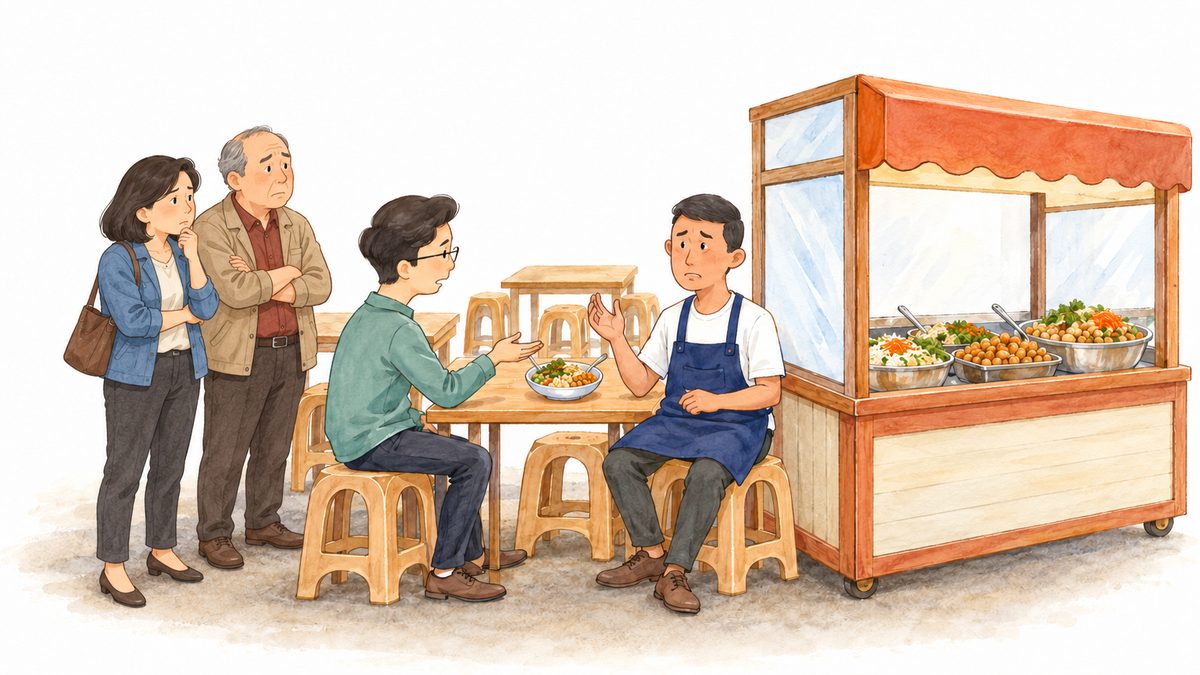
Together with local employees, he refined the comic until it felt at home in their culture. That is how a management model became a story everyone understands—in 30 minutes, at their own workplace.

We still carry this lesson forward today: meet people where they are—in their place, in their language, at their level of training. Today such training is part of KAIZUNO as e-learning modules—playful ones too, for everyone who wants to get to know it better. And yet at its core it needs no technology: just the five steps—and a story everyone understands.