Industries · Same topics, different conditions
KAIZUNO® strengthens organizations
and their people from within.
A sailboat on a lake needs different instruments than a cruise ship on the Atlantic. On both, people have to set the course, read the conditions and reach their destination safely.
A dental practice and a hospital group differ in just the same way. KAIZUNO offers you solutions that fit your industry and your initiative.

Your industry, your rules.
KAIZUNO adapts.
You know your customers, the rules that apply and how people work together in your organization. This knowledge flows into your initiative. If needed, experience from the partner network is added.
Different worlds of work, concrete tasks.
Insights into industries where KAIZUNO has already been used.
Industry and skilled trades
When materials are missing or hands-on knowledge is lost, orders stall. Production, purchasing and service have to work together.
Examples from our work: a hydrogen project in the automotive industry and a family-run electrical company.
Mobility and services
Customers expect availability. Vehicles, technology and staff have to be ready at the right time—even when plans fall apart at short notice.
Examples from our work: a mobility service provider.
Health and care
Every treatment depends on different professionals working together. Handovers and clear responsibilities have to work under time pressure.
Examples from our work: several clinics and a dental practice.
There are dedicated offerings for the dental industry and for nursing and long-term care, in German: dentalbranche-gestalten.com and pflege-systematisch-entlasten.com.
Education and religious institutions
Programs have to suit the learners and stay affordable. In religious institutions, faith shapes their identity and their daily work.
Examples from our work: an adult education center (Volkshochschule) in Germany, quality management at OTH Amberg-Weiden, a university of applied sciences in Bavaria, and Haus Ohrbeck, a Christian education center.
Public administration
Legal requirements and individual life situations meet limited budgets. Decisions have to be traceable and reach the people they serve.
Examples from our work: organizational development in several Jobcenters, the public employment services in Germany.
For public employment services—Jobcenter in Germany, RAV in Switzerland and AMS in Austria—there is a dedicated offering: arbeitsmarkt-integration.com.
Financial services
Customers need the right advice and reliable decisions. Profitability, diligence and regulatory requirements have to fit together in daily work.
Examples from our work: a Volksbank, a German cooperative bank, that wants to lead by example on sustainability.
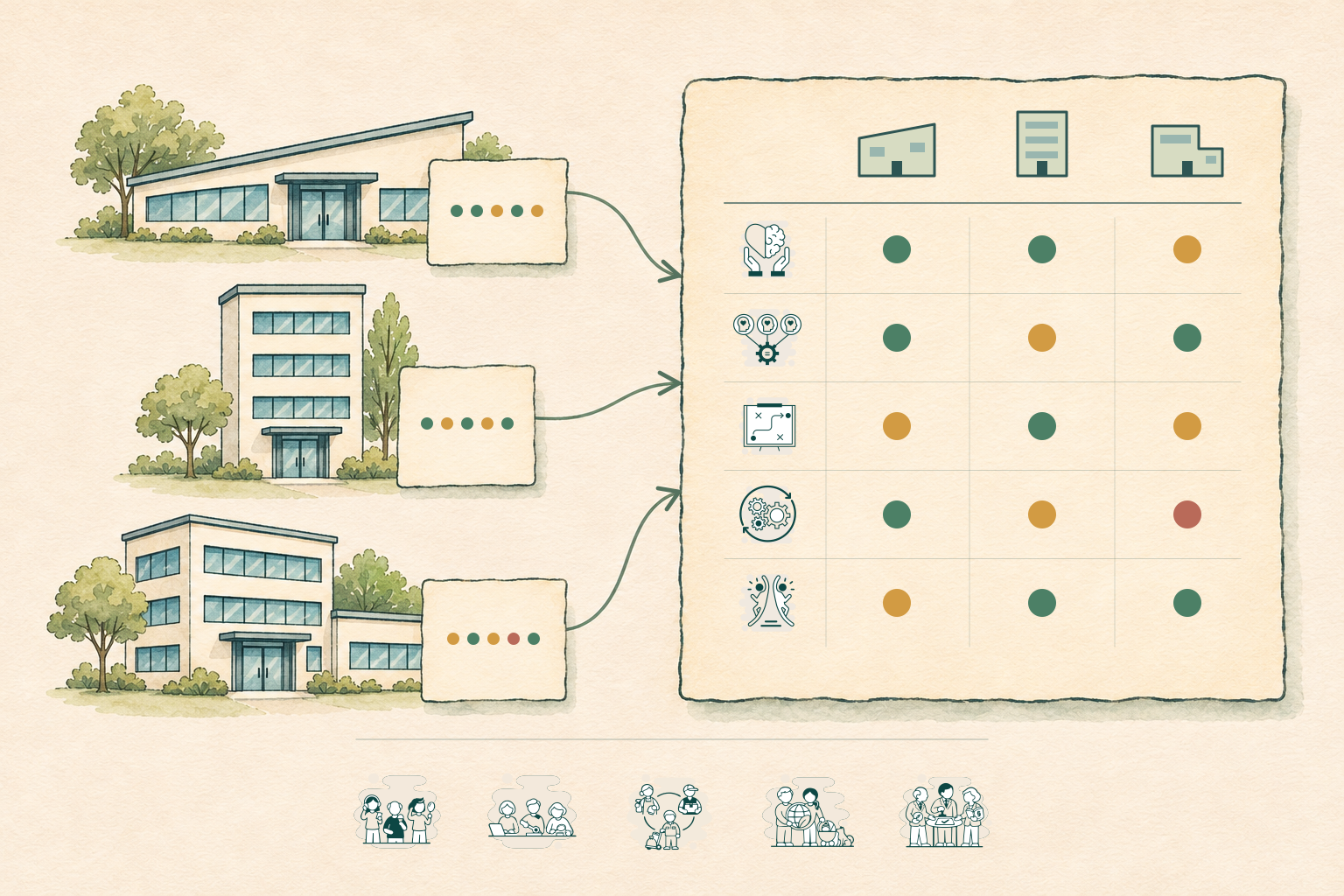
For groups with many locations.
Is your organization spread across many places, such as clinics, care homes, daycare centers, hotels or schools? And you want to know how things really run everywhere?
- Each place assesses itself on the same topics, with its own particularities.
- Each receives its own report.
- Together, this gives you a real overall picture.
You see where things go well, where support helps and who can learn from whom.
In practice · OTH Amberg-Weiden
A university of applied sciences that thinks about quality across all its campuses.
Quality at universities is well regulated—from the Bologna Process to Bavaria’s Higher Education Innovation Act. But the real driver is not obligation: every university wants a clear profile and a future, competing for students and staff alike. Everyone knows the hurdles, the large university as well as the university of applied sciences: teaching, administration and research work side by side, knowledge sits in many heads—and quality is quickly seen as a burden on top of day-to-day work.
How do you bring a whole university to a shared understanding of quality?

“Using KAIZUNO, our university succeeded—in a joint, cross-departmental effort by all members of the university—in creating an agreed vision for a strategically aligned understanding of quality.”
Prof. em. Dr. Wolfgang Renninger · Academic Director of Quality Assurance, OTH Amberg-Weiden
The full story
OTH Amberg-Weiden is system-accredited—its quality assurance as a whole is accredited, not each degree program separately—and its quality processes are documented. It wanted to take the next step: to turn a system that meets the requirements into one that carries the whole university strategically. “Experience shows that academic structures are generally not yet sufficiently prepared for this,” says Prof. Renninger. Suitable approaches and tools are needed, he says, to get from structures that have grown over time to solutions people can act on. Against this background, OTH deliberately chose KAIZUNO.
More than 50 experts from three teams—from quality management and administration to university leadership—assessed their university themselves along the five KAIZUNO steps, in the spirit of a learning organization, across topics from processes and digitalization to internationalization. In this way, potential became visible “very quickly, even across heterogeneous groups,” with concrete approaches to solutions and improvement measures. The AI supported “the completeness and objectivity of the findings.”
In joint workshops, the teams then brought their results together: they saw one another’s perspectives and worked out the solutions together.
The result: an agreed vision for a strategically aligned understanding of quality, supported by all members of the university, and practical recommendations for the quality management system. Renninger calls the benefit “considerable”: it reaches from teaching, research and transfer into administration and management. What remained is not another report for the file—but an organization that has decided together and acts together.
“The fast and reliable implementation of feedback, the flexibility with changes and the open, respectful communication made working together especially pleasant.”
Alex Schmid and Sabine Märtin · on behalf of the quality management team at OTH Amberg-Weiden
In practice · Public employment services
Jobcenters that develop from within.
Jobcenters, Germany’s public employment services, have a demanding mandate: they secure livelihoods and bring people back into work—with a lot of money, in the public eye, and they carry out whatever politicians decide. They are expected to do right by everyone at once: job seekers, employers, their own staff, the decision-makers. A balancing act, every day—and time and again a reform changes the rules. Yet change usually comes from the top. Rarely does anyone ask what the team itself sees.
But what if a Jobcenter developed from within?
“KAIZUNO helped our Jobcenter teams shape their future without disrupting operations. Simple, self-directed—practical reports and clear next steps.”
Eric Schaffrath · Barbara Limmer · Jürgen Bayer · Jobcenter Bayreuth Stadt
The full story
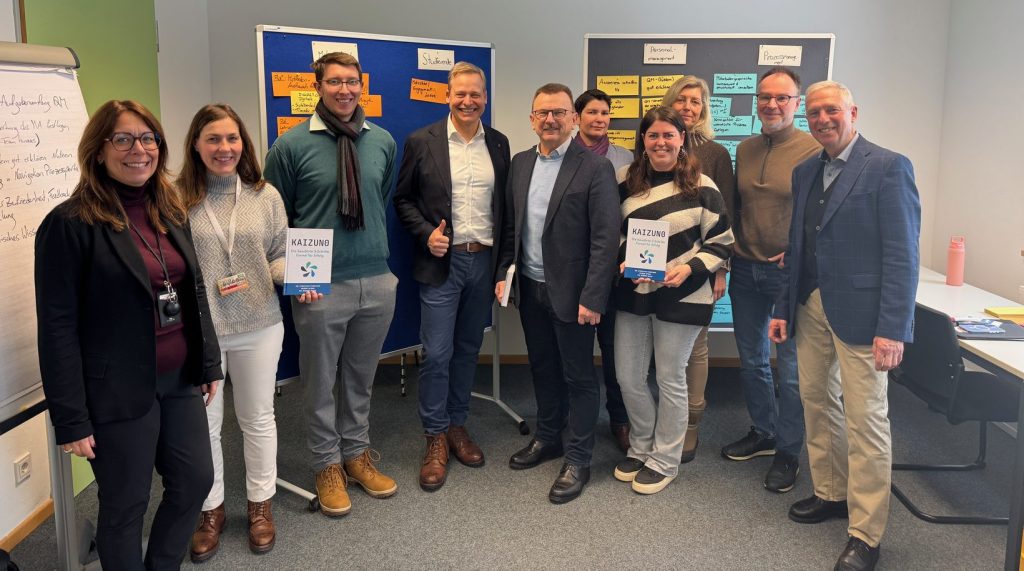
In Bavaria, exactly that is happening: the Jobcenters of Bayreuth Stadt, Ebersberg, Freising, Landkreis Starnberg, Regensburg and Weiden-Neustadt have involved their teams—in the middle of the balancing act, alongside day-to-day work. More are joining.
Each team looked at its own work from every side—with questions from daily practice: How do we support those who do everything digitally, and those who struggle with it? How do we document so that others can pick up the work? How do we work better together—with one another, with the city, with employers? And do we send businesses the applicants who are the right fit?
One of the other Jobcenters shows what such an assessment looks like—which one, we keep to ourselves. It is in the middle of implementing a major reform. More than 50 employees took part, individually or as a team. Every question was voluntary—and still more than 7,500 ratings came together, along with more than 140 comments in their own words. More than 2,200 times the team saw a strength, more than 1,400 times a potential.
The KAIZUNO system puts this wealth of input together like a puzzle and condenses it, step by traceable step, into an honest overall picture—work that could hardly be done by hand. It shows what remains unspoken in many organizations: where the team is strong, where its work can get better, what depends on what—and where it takes things for granted without knowing. The report also shows where views differ. It even states openly which results are robust and which should be read with caution.
What pleased us most: how committed the employees were. And how many real starting points came out of it—concrete and from their own daily work.
At the end there are no general recommendations, but concrete next steps, with benefit and effort. The team decides for itself what to tackle when. That is how even a public agency develops from within. And the task is the same everywhere—whether Jobcenter in Germany, AMS in Austria or RAV in Switzerland.
For us at KAIZUNO, this is some of the most valuable work we do: what gets better in a Jobcenter has an effect beyond it—on the labor market and on the people who depend on this support.
For Jobcenter, RAV and AMS there is a fitting way to start: a baseline assessment while operations continue.